

How to Tell If Your Rudraksha Is Real
- How to identify a physically authentic Rudraksha
- 1. Check the mukhi lines
- 2. Feel the texture
- 3. Weigh it
- 4. Look for natural imperfection
- 5. Inspect the finish
- 6. Use the water test, carefully
- A note on X-ray testing — and why we do not recommend it
- Where the Rudraksha comes from: Nepal, India, or Indonesia
- Price as a signal
- Question 1: Who is your teacher?
- Question 2: How is the Rudraksha actually activated?
- Question 3: What is your relationship to the Rudraksha after the sale?
- Red flags that should make you walk away
- How to care for your Rudraksha
- Frequently asked questions
- Is there a single foolproof test for authenticity?
- Is X-ray testing reliable for Rudraksha?
- Can a fake Rudraksha still work spiritually?
- Does the origin — Nepal versus Indonesia — determine authenticity?
- What does it mean for a Rudraksha to be activated?
- How do I know if a seller has a real lineage?
- Should I be worried about buying Rudraksha online?
- What if I already bought a Rudraksha and now I am unsure?
- A final word
You have probably already read the lists. The mukhi count. The water test. The lab-certified X-rays. By now you can spot a glued bead in a marketplace photo.
And still — something does not quite settle.
That is because the deeper question is not whether the seed is real. It is whether the bead carries anything.
Most articles on identifying authentic Rudraksha cover only half the picture — the physical half. This piece covers both. The visible signs of a genuine Rudraksha, taught the way they are meant to be taught. And the part the rest of the internet leaves out: what makes a Rudraksha alive
The two layers of an authentic Rudraksha
An authentic Rudraksha is two things at once: a genuine seed from the Elaeocarpus ganitrus tree, and a power object that has been activated through a real spiritual lineage. Most sellers can speak to the first. Almost none can speak to the second. Understanding both is how serious seekers avoid expensive mistakes.
In the modern market, "authenticity" almost always refers only to physical identification — origin, mukhi lines, mineral composition, laboratory testing. These matter. A bead that has been cut, glued, or chemically altered is not a Rudraksha at all.
But a Rudraksha is not merely a seed. In the Vedic tradition, every physical object carries Shakti — divine power — most of which remains dormant until it is awakened. Rudraksha are considered sacred for two reasons. They radiate more inherent Shakti than other natural objects. And since ancient times, spiritual masters have activated them through transmission, for their own use and for their students.
A Rudraksha that has been verified physically but never activated is still authentic as a seed. It is not yet a power object.
This is the distinction the rest of this guide is built on.
What Science says about Rudraksha
Rudraksha have measurable electromagnetic, paramagnetic, and weak ferromagnetic properties — documented across more than five decades of peer-reviewed research. This is not the whole story of what a Rudraksha is. It is the part that can be measured.
The foundational work came from Dr. Suhas Roy (also published as Subas Rai) at the Indian Institute of Technology in Banaras (IIT-BHU) in the late 1960s. His research showed that Rudraksha possess distinct electromagnetic properties and interact with the body's bioelectric field through dynamic polarity. When worn over the heart, the bead responds to the magnetic field created by blood circulation, transmitting opposing-polarity impulses that have been shown to help stabilize heartbeat and circulation.
More recent work has refined this picture. Sharma et al. (2019), publishing in the International Journal of Scientific & Technology Research, used three independent measurement techniques — Vibrating Sample Magnetometer (VSM), Superconducting Quantum Interference Device (SQUID) magnetometry, and Electron Paramagnetic Resonance (EPR) spectroscopy — to characterize Rudraksha beads. They found weak ferromagnetic behavior, with measurably different magnetic signatures across different mukhis. They also identified the bead's trace mineral composition through Energy Dispersive X-Ray Fluorescence (ED-XRF): copper, magnesium, iron, silver, and zinc — the same metals known to support electromagnetic activity in other contexts.
Other studies have measured Rudraksha's dielectric properties, capacitance, and inductance. Taken together, the research describes the bead as a natural bioelectric component — not merely a piece of wood.
A few honest notes on this body of work.
First, peer-reviewed research on Rudraksha is real but still relatively sparse. Most studies are published in regional Indian journals rather than the highest-tier international ones, and independent replication has been limited. We treat the findings as meaningful but not closed.
Second, and more importantly: none of this measures Shakti. The electromagnetic profile of a Rudraksha is part of what makes it a power object — not the whole of what makes it one. Activation, transmission, and lineage operate at a layer no instrument has been designed to detect. Science describes one floor of the building. The tradition describes the rest.
What the research does confirm clearly is that something physically measurable is happening inside a real Rudraksha. That is not nothing. It is also not everything.
For a fuller look at the studies, the techniques used, and what each one actually measures, see our companion piece: The Science About Rudraksha — what research has and has not shown LINK
How to identify a physically authentic Rudraksha
The physical authentication of a Rudraksha rests on six observable qualities: the mukhi lines, the texture, the weight, the symmetry, the surface finish, and the response in water. No single one is foolproof. Together, they are reliable.
1. Check the mukhi lines
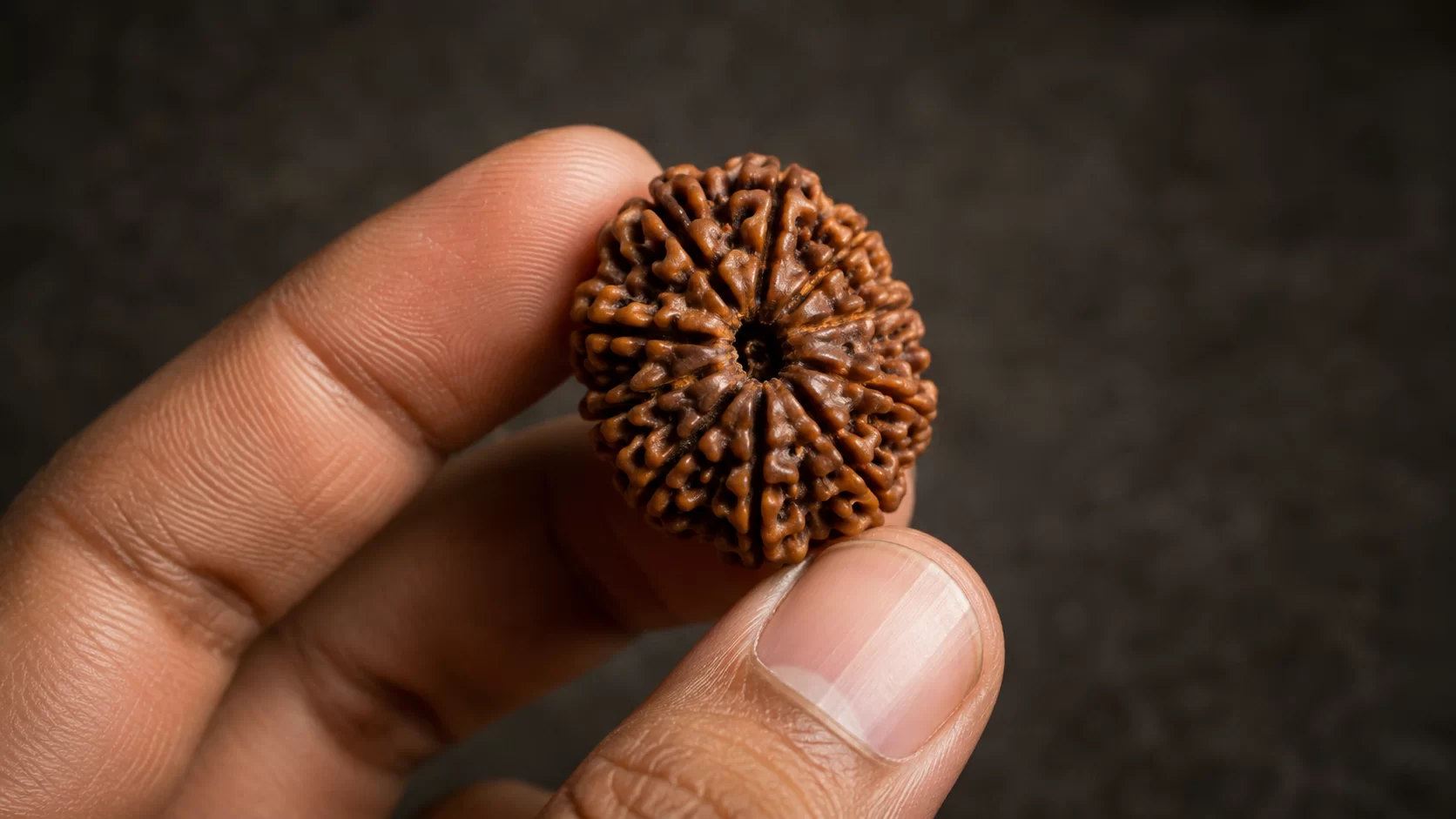
A real Rudraksha has natural vertical grooves — the mukhis, or faces — running from the top of the bead to the bottom without breaks. Each line should be continuous, distinct, and slightly irregular. Fake or altered beads have grooves that are too shallow, too symmetrical, painted, or carved.
Examine under good light, ideally with a magnifier. A natural mukhi follows the contour of the seed. A carved one does not.
2. Feel the texture
A real Rudraksha feels firm but lightweight, with a slightly rough, organic surface — never glassy. Wood or plastic imitations feel too smooth or too polished. Synthetic resins often feel waxy. Authentic seeds have minor pits and surface variation you can feel with your thumb.
3. Weigh it
Authentic Rudraksha beads are surprisingly light for their durability. Plastic or resin imitations can feel hollow. Stone or metal-weighted fakes feel heavy in a way that gives them away the moment you hold one. Once you have held a real Rudraksha, you will recognize a fake by feel alone.
4. Look for natural imperfection
A genuine Rudraksha is never perfectly symmetrical. Each bead from each tree is slightly different — irregular shape, variable line depth, small natural marks. Beads that look identical across an entire mala are a warning sign. Authentic Rudraksha do not match.
5. Inspect the finish
Real Rudraksha have a matte or slightly dull surface, never glossy. Excess shine usually means polish, lacquer, or chemical treatment to mask defects. A subtle natural sheen develops over years of wear — but it is earned, not applied at the factory.
6. Use the water test, carefully
The traditional water test is a quick check, not a verdict. Drop the bead into a glass of clean water. Most genuine Rudraksha sink. Most fakes float. But there are exceptions. Real beads with internal air pockets sometimes float. Weighted fakes can sink. Use this test alongside the others, never alone.
A note on X-ray testing — and why we do not recommend it
We do not recommend X-ray testing for Rudraksha, despite how often it is offered as a premium authentication service.
The position came clearly when we asked Sri Sai Kaleshwara Swami about X-ray testing directly. He dismissed the question — looking at us with the kind of expression that says why are you even asking this? That dismissal carried more than words.
What Swami did teach explicitly is foundational: there is no perfect test. The bead's authenticity is not, in the end, a question of measurement. It is a question of discernment — what he called the inner eye. The physical checks in this guide will catch obvious fakes. The lineage questions in the next section will identify trustworthy sources. But the final knowing comes from your own attention to the bead in your hand.
As for why we believe X-ray testing is best avoided — that interpretation is ours, not Swami's. Here is the reasoning, grounded in the science.
A Rudraksha is a living power object with a measurable natural electromagnetic field. This is not a claim from tradition alone — it is peer-reviewed research. Foundational studies by Dr. Suhas Roy at the Indian Institute of Technology in Banaras (IIT-BHU) in the late 1960s established that Rudraksha possess distinct electromagnetic, paramagnetic, and dynamic-polarity properties, and interact with the body's bioelectric field — particularly when worn over the heart. More recent work, including Sharma et al. (2019) in the International Journal of Scientific & Technology Research, used Vibrating Sample Magnetometer (VSM), Superconducting Quantum Interference Device (SQUID) magnetometry, and Electron Paramagnetic Resonance (EPR) spectroscopy to confirm weak ferromagnetic behavior in Rudraksha — with measurably different electromagnetic signatures across different mukhis.
X-rays are ionizing radiation. In organic materials, ionizing radiation reliably produces paramagnetic free radicals — this is so well-documented that irradiated organic samples are routinely used as radiation dosimeters in EPR research. Whether and how diagnostic X-ray imaging specifically alters a Rudraksha's electromagnetic profile has not yet been formally tested in any study we have found. But the underlying principle is established. The precaution follows from it.
An X-rayed Rudraksha may still pass every visual check. We believe its energetic function may quietly no longer be intact. We have not put our beads through that process, and we would not.
This is a quieter answer than most articles give. It is also the truer one.
Where the Rudraksha comes from: Nepal, India, or Indonesia
Authentic Rudraksha grow primarily in Nepal, India, and parts of Indonesia, and beads from each region have slightly different characteristics. Nepali Rudraksha are larger, with thicker, more pronounced mukhi lines, which makes them easier to identify and more expensive on the market. Indonesian Rudraksha are smaller and smoother, with finer features.
Both are genuine. Both work. The Vedic texts do not favor one over the other. What matters is that the seed is real and that it has been properly activated.
Be cautious of sellers who insist only one origin is acceptable, especially if they happen to sell only that origin. The Shakti of a Rudraksha is not a function of its passport.
Price as a signal
Authentic Rudraksha — especially the rare mukhis (1, 9, 14, and certain others) — cannot be cheap. The 1 Mukhi in particular is produced at a rate of at most one seed per tree per year, sometimes none at all. Its market price reflects that scarcity.
If a "1 Mukhi pendant" is listed at the price of a generic mala bead, it is not a 1 Mukhi. If a rare mukhi shows up at a steep discount, ask why.
Premium pricing does not guarantee authenticity. But suspiciously low pricing reliably indicates the opposite.
Looking for Rudraksha that have been verified physically and activated in lineage? Explore our collection of authentically activated Rudraksha meditation malas — each bead inspected at our Ubud Sacred Jewelry Sanctuary and blessed in the lineage of Sri Kaleshwar.
The deeper layer: how to evaluate spiritual authenticity
A Rudraksha that has not been activated is functionally a beautiful, rare seed. A Rudraksha that has been activated by an unbroken lineage carries the actual transmission of Shiva. This is the part most sellers will not discuss — usually because they cannot.
Activation is not a marketing claim. It is a process — extended mantra, yantra, and Shakti transmission performed by a teacher with the authority to do so. The transmission awakens the dormant Shakti of the seed and stabilizes it for the wearer.
Here is how to evaluate a seller on this dimension. Ask these three questions.
Question 1: Who is your teacher?
A real lineage has a named source. A seller who cannot tell you their teacher's name, the lineage that teacher belongs to, and where they received authorization to bless objects is not in a position to activate anything. Vague references to "ancient tradition" or "energy work" are not lineage.
We answer this directly. Our founders, Swathimaa and Raymond Prohs, lived at Sri Kaleshwar's ashram in Penukonda, India, from 2001 to 2012. The activation process used at Shivaloka was given by Sri Kaleshwar, in the lineage that flows from Shirdi Sai Baba and the Divine Lineage.
Question 2: How is the Rudraksha actually activated?
The answer should be specific. A real process involves identifiable steps — the mantras used, the duration of the activation, the conditions under which it is performed. "We bless every bead" is not a process. It is a phrase.
Question 3: What is your relationship to the Rudraksha after the sale?
A lineage-rooted seller will remain available to you — for questions, for replacement if the bead breaks, for guidance on practice. A drop-shipper will not. A Rudraksha is a relationship that extends beyond the moment of purchase. The seller should be too.
Red flags that should make you walk away
Six warning signs appear repeatedly across counterfeit and over-marketed Rudraksha listings. Any one of these is a reason for caution. Two or more is a reason to walk away.
- The bead is glossy, polished, or unnaturally uniform in color
- Every bead in the mala looks identical
- The price is dramatically lower than the market for that mukhi
- The seller claims a guaranteed outcome — wealth, healing, instant transformation
- The seller cannot name their teacher or lineage
- There is no possibility of return, replacement, or human contact after the purchase
A Rudraksha is a relationship — with the bead, with the lineage that activated it, and ideally with the people who handed it to you. Anything that breaks that chain is a sign.
How to care for your Rudraksha
Once you have a verified, activated Rudraksha, basic care protects both its physical integrity and its energetic stability. Keep it away from harsh soaps, chlorinated water, alcohol, and synthetic perfumes. Wipe it gently with a soft, dry cloth.
Every few months, apply a small amount of natural oil — mustard, sandalwood, or pure almond oil — to keep the seed from drying out. This deepens the natural color and preserves the surface for decades.
When not worn, place the Rudraksha on your home altar in plain view, or wrap it in silk and rest it under your pillow.
A well-cared-for Rudraksha lasts a lifetime — and is often passed on.
Frequently asked questions
Is there a single foolproof test for authenticity?
No. There is no perfect test — this was a direct teaching from our lineage. The water test, visual inspection, weight, and texture each catch some fakes but not all. Reliable identification combines multiple physical checks, an evaluation of the seller's lineage, and your own discernment in handling the bead. Anyone offering a single guaranteed test is overstating what is possible.
Is X-ray testing reliable for Rudraksha?
We do not recommend it. Rudraksha have documented electromagnetic and paramagnetic properties — measured in peer-reviewed studies by Dr. Suhas Roy at IIT-BHU and more recently by Sharma et al. (2019) using SQUID and EPR techniques — and ionizing radiation is known to alter the electromagnetic profile of organic materials. Whether X-ray imaging specifically damages Rudraksha has not been formally tested. We treat the precaution as warranted by the underlying science and do not put our beads through that process.
Can a fake Rudraksha still work spiritually?
No. A counterfeit Rudraksha is not a Rudraksha — it is a piece of wood, resin, or treated seed. It carries no Shakti, regardless of how it is sold or worn. Wearing one as a Rudraksha will not produce the effects described in the Vedic texts, no matter the intention behind it.
Does the origin — Nepal versus Indonesia — determine authenticity?
No. Both Nepali and Indonesian Rudraksha are authentic when the seed is genuine and the activation is real. Nepali beads tend to be larger with more pronounced mukhi lines; Indonesian beads are smaller and smoother. Sellers who insist only one origin counts are usually selling that origin.
What does it mean for a Rudraksha to be activated?
Activation is the spiritual process by which a Rudraksha's dormant Shakti is awakened through transmission from a qualified teacher. It involves specific mantras, yantras, and processes recorded in the Vedic tradition. An unactivated Rudraksha is still a genuine seed, but it does not yet function as a power object.
How do I know if a seller has a real lineage?
Ask directly. A seller in a real lineage can name their teacher, describe how they received authorization, and explain the specific activation process used. Vague references to "ancient tradition" without specifics are usually marketing. A real lineage holds up under direct questioning.
Should I be worried about buying Rudraksha online?
Not necessarily. Many of the most authentic sources are online, especially for buyers outside India and Bali. What matters is the seller's transparency. Look for clear lineage documentation, photos of the actual production space, and a return policy. Generic stock photos and anonymous customer service are warning signs.
What if I already bought a Rudraksha and now I am unsure?
Apply the six physical checks above. If those pass, the seed is likely genuine. If you cannot determine whether it was activated, you can either wear it as a sincere ornament and let the bead lead you to its successor, or you can replace it. Many sellers — including Shivaloka — will help evaluate a bead you already own.
A final word
Buying an authentic Rudraksha is not a transaction. It is the beginning of a relationship — with a seed, with a lineage, and with a practice. The seed itself takes only a few minutes to verify. The lineage takes longer to evaluate, but it is the part that determines whether the bead does what the tradition says it does.
If the Rudraksha you are considering passes the physical checks and the lineage questions, you have found something rare.
If you are still looking — or want to compare what you have found against a source that can answer both — explore our [INTERNAL LINK: authentically activated Rudraksha collection], or read our [INTERNAL LINK: full guide to the 1 Mukhi Rudraksha] for a closer look at the most powerful bead in the tradition. Each piece at Shivaloka is selected, prepared, and blessed in the lineage of Sri Kaleshwar at our [INTERNAL LINK: Ubud Sacred Jewelry Sanctuary] on Jalan Hanoman.
What you wear matters. What it carries matters more.
Discover Your Personal Power Bead According To Your Birth Chart

How to Tell If Your Rudraksha Is Real
You have probably already read the lists. The mukhi count. The water test. The lab-certified X-rays. By now you can spot a glued bead in a marketplace photo. And still — something does not quite settle. That is because the deeper question is not whether the seed is real. It is whether the bead carries […]
READ THE ARTICLE
Unlocking Wealth & Fertility
According to India’s ancient spiritual texts, the 18-Mukhi Rudraksha attracts tremendous wealth and increases one’s powers of creativity. Known to help increase one’s fertility, in both body and mind. This rare, sacred rudraksha is cherished by those longing to express and manifest something from within in any sphere of life, whether worldly or divine. Since […]
READ THE ARTICLE
Overcome Hardship & Grief
According to India’s ancient spiritual texts, the 17-Mukhi Rudraksha protects against overwhelming negativity and the debilitating grief that arises as a result. It’s shakti helps heal the pain and suffering carried over from past life karma. This rare, sacred rudraksha is profoundly cherished by those faced with seemingly insurmountable obstacles to their success in any […]
READ THE ARTICLE
Confident, Enlightened Leadership
“It’s always sunny above the clouds. Always. Every day on earth—every day I’ve ever had—was secretly sunny, after all.” – Caitlin Moran There’s no need for the sun to ever be a hidden secret again. Ever. The same ultimately divine power that illuminates it, and us, radiates from within our souls, too. That power is […]
READ THE ARTICLE
Rise in Bliss Consciousness
According to the ancient texts, the power of the 15-Mukhi Rudraksha helps raise one’s consciousness to experience states of bliss. Its inherent shakti (high vibrations), once fully activated, helps open one’s awareness to the subtlest level of awareness, Ritambhara Pragyam, “where only the Truth is known”. From that state, your heart’s deepest desires readily manifest. […]
READ THE ARTICLE
Remove the Obstacles
to Success
Since ancient times, India’s supreme spiritual masters have used the Ganesh Mukhi Power Rudraksha to create tremendous success in their divine work for humanity, cherishing the miraculous wisdom and transformational powers that come as a result. The eternal gift of the Ganesh Power Rudraksha is its ability to clear your path from blocks and control […]
READ THE ARTICLEJoin Our Sacred Circle & Get 10% Off
Sign up to receive exclusive access to ancient wisdom, divine offers and soulful events. Let the sacred flow into your inbox.
0 comment
Leave a Comment